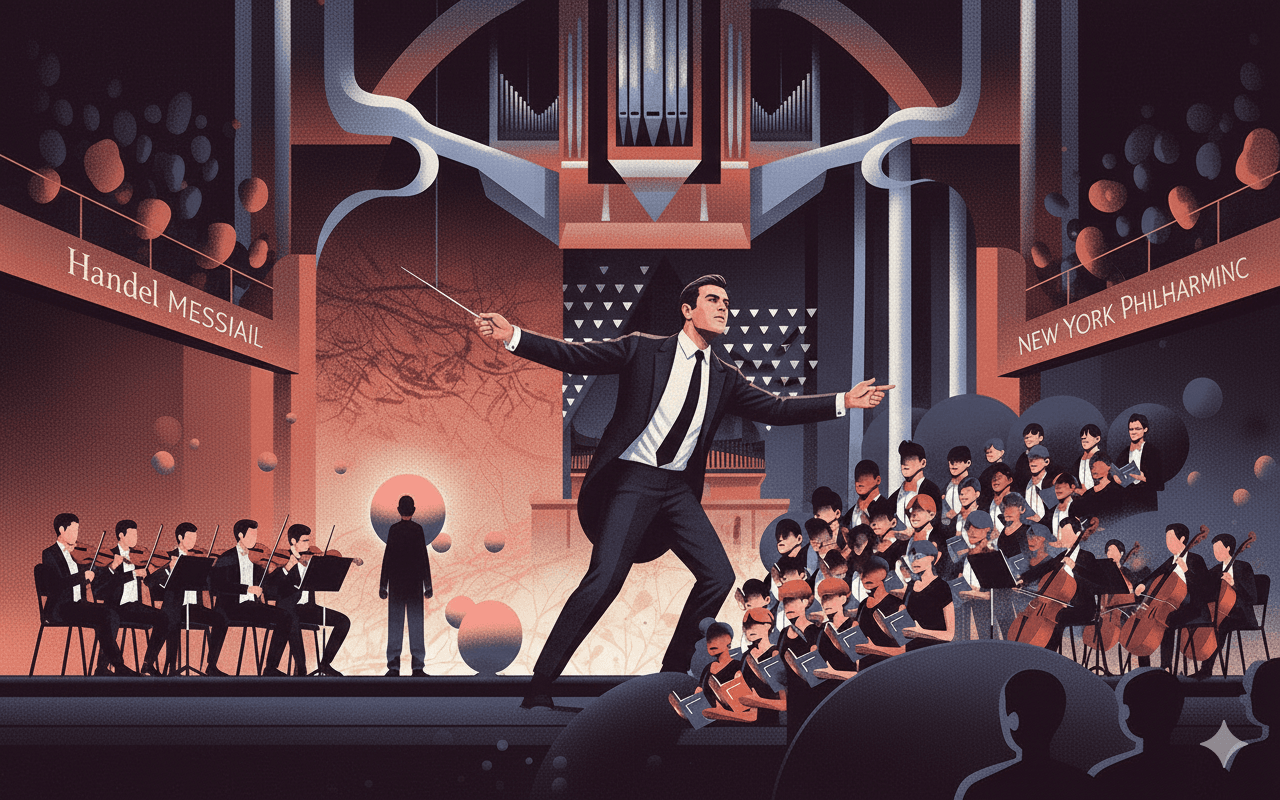
In the fall of 2008, as the financial crisis reached its culmination, Gary Parr occupied a unique position. He served as vice chairman at Lazard, a prestigious investment bank, where he negotiated the sale of Merrill Lynch to Bank of America. Simultaneously, he assumed the chairmanship of the New York Philharmonic. Amidst the collapse of the global financial system, he made a decision that seemed disonant with the chaos of the moment. He decided to endow Handel’s Messiah
This story follows that decision. It explores the construction of a system in America where high culture relies on a sequence of accidents. These are accidents of timing, taste, and childhood exposure. This narrative details hidden rules and unspoken bargains. It begins with a simple question: What is the true cost of keeping Beethoven alive?
A ticket to the New York Philharmonic cost $120 but thats 35 percent of an actual ticket because Gary Parr estimates that a break-even ticket would cost between $400 and $500. At that price, the audience vanishes.Consider the orchestra. One hundred musicians represent the result of 10,000 hours of practice. These are virtuosos. When the Philharmonic announces a violin opening, 400 applicants submit recordings. They perform behind screens in sneakers to ensure anonymity. They receive five or six minutes to demonstrate their ability.
This process ensures excellence and creates immense expense. One hundred musicians require living wages, benefits, and instruments costing thousands of dollars
There is an established rule ,in the Eupoean world governments finance orchestras whilest in America individuals provide the capital .A goof case is The Berlin Philharmonic: they receives over 90 percent of its budget from the German government. The New York Philharmonic receives less than one percent from American government sources
In Europe, the assumption exists that the state pays for important things. In America, the assumption is that individuals pay for important things. These are distinct theories of society.So the case becomes cultural but also parr urgues a small case of reality where European board members often cite American tax deductions as the primary driver of this behavior.
Gary Parr grew up in North Carolina during the 1960s and 70s. His father played records, but the town lacked an orchestra. A future as a classical music patron seemed improbable.
A specific event changed his trajectory. As a teenager, his aunt and uncle invited him to hear a new CD player. They played Tchaikovsky’s 1812 Overture. This piece features real cannons recorded into the orchestration.Parr listened. When the music ended, he thought: “That’s really cool. You could have music with cannons.”
Psychologists identify this as a “crystallizing experience.” It is the moment an individual’s future passion comes into focus. Without that specific recording at that specific moment, Parr likely never endows Handel’s Messiah.
In 15th-century Florence, the Medici family especially Cosimo and Lorenzo the Magnificent, funded iconic Renaissance artists like Michelangelo, Botticelli, and Leonardo da Vinci, along with architects like Brunelleschi, and thinkers like Machiavelli & Galileo, fostering immense artistic and scientific growth, even financing major constructions like parts of the Florence Cathedral and St. Peter’s Basilica, and helping develop the piano and opera.
The Medicis recognized that culture is infrastructure Public art made Florence attractive to merchants and drew talent from across Europe. They invested in quality of life to attract human capital.
Parr applies this logic to education. He argues that exposure to the arts improves leadership and cultural understanding. He identifies a tenth-grade teacher who taught him Julius Caesar as a primary influence. The lesson centered on rhetoric: the power to persuade and tell stories that shift public opinion.
In 2010, Parr encountered a counter-intuitive observation: “The New York Philharmonic plays too often in New York.”
The logic relied on scarcity. Over-saturation in one market limits the ability to command premium prices. Parr looked to China and proposed a residency program. Madame Deng Rong advised him: “Go to Shanghai.“
The Shanghai residency has operated for fifteen years.They possessed magnificent halls and soloists, but they lacked functional orchestras.During this time, Chinese officials told Parr: “We have the hardware. We don’t have the software.”
Long Yu, a conductor, explained the deficiency. China excelled in individual sports like ping pong and gymnastics. It struggled in team sports like soccer and basketball. The Chinese system emphasized individual excellence as a path to upward mobility. It did not produce the collaborative skills required for an orchestra. In America, orchestras survive through the collaborative act of collective giving.
Becoming an orchestral musician requires some priviledges likely, born from wealthy,early exposure and a temperament suited for isolation and practice.Sociologist Annette Lareau calls this “concerted cultivation.” It is an intensive parenting style that provides organized activities and a sense of institutional entitlement. The Philharmonic draws from a pool of candidates previously winnowed by class.
Expanding the audience for classical music requires expanding childhood exposure. This requires teachers, instruments, and affordable concerts. Parr describes this as creating balanced people. It is the democratization of the hidden curriculum.The Philharmonic board debated the future of Messiah in 2010. Parr insisted that tradition must be a good idea to warrant continuation.
The board reviewed alternatives, including movie concerts where the orchestra plays soundtracks for films like Jaws. These events generate significant revenue. They kept Messiah because it was financially viable. Tickets sold and tourists attended.
The American model requires every program to justify its existence. In Europe, directors make aesthetic choices supported by the state. In America, every tradition earns its keep or it disappears.Gary Parr’s trajectory as a patron began with the sound of cannons. A single recording in North Carolina set in motion the endowment of Handel’s Messiah decades later.
This story describes a series of accidents. Parr might have missed that recording. He might have chosen a profession that did not generate wealth. The American system of patronage relies on a supply of individuals who have the experience, gain the education, and decide to give.”I wish there were more,” Parr says regarding arts philanthropy.
When the playbill credits Gary W. Parr for Handel’s Messiah, it marks the result of a teenager hearing cannons and finding them cool. It is the result of aligned accidents. It is the system we have constructed.